
Die Organisation Knowledge Economy International (KEI) hat die neueste konsolidierte Fassung (PDF) des Dokuments über das Anti Counterfeiting Trade Agreement (ACTA) veröffentlicht (Wiki-Version) – trotz intensiver amerikanischer Bemühungen, den Text geheim zu halten. Er beinhaltet nun alle Änderungen, die während der Verhandlungsrunde in Washington DC beschlossen wurden. Von einer Three-Strikes-Regelung ist aber immer noch die Rede (In Section 4, Art. 2.18.4):
Each Party may provide, in accordance with its laws and regulations, that its competent authorities have the authority to order an online service provider to disclose expeditiously the information of the relevant subscriber to the right holders, who have given legally sufficient claim with valid reasons to be infringing their {US: copyright or related rights}{J/EU: intellectual property rights}.
Der Sprecher der Quadrature du Net hält diesen Artikel im Hinblick auf Privatsphäre und Datenschutz für sehr bedenklich:
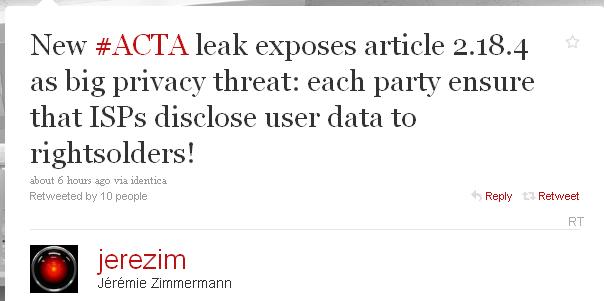
Insgesamt kann festgestellt werden, dass einige Passagen nun eher vage gehalten sind:
Each Party’s enforcement procedures shall provide the means to address the infringement of {US: copyright or related rights}{ EU/J: intellectual property rights in the digital environment, including infringement that occurs via technologies [US: or services] that can be used to facilitate widespread infringement.29 These procedures shall be implemented in a manner that avoids the creation of barriers to legitimate activity, including electronic commerce, and, consistent with each Party’s law, preserves principles relating to freedom of expression, fair process, and privacy [EU: , among other [US: fundamental] principles]. (Section 4, Art. 2.18.2.)
Michael Geist hat folgende Schlüsselelemente aus dem letzten Internetkapitel-Leak gebloggt:
1. There is still disagreement on scope – the EU wants it to apply to all intellectual property, while the U.S. would limit to copyright and trademark. This disagreement occurs throughout the ACTA text.
2. Each party is now required to provide the means to address infringement in the digital environment, including unlawful file sharing and streaming. There are no specific requirements and the provision notes that these procedures must preserve principles related to freedom of expression, fair process, and privacy.
3. The secondary liability provisions that focused on ISP liability have been dropped entirely. Instead, the chapter requires countries to promote cooperative efforts with the business community to address infringement and says that countries may provide that authorities have the power to order ISPs to disclose subscriber information. Note that the disclosure power is not a requirement but rather something a country „may“ do.
4. The anti-circumvention provisions remain somewhat in play. There is general agreement on a broad provision that largely mirrors the WIPO Internet treaties in calling for „adequate legal protection and effective legal remedies against the circumvention of effective technological measures.“ If the obligation were to end there, the provision would simply ensure that all ACTA countries establish anti-circumvention rules, with all the flexibility that WIPO allows.
Über ACTA wird an diesem Mittwoch im Europäischen Parlament diskutiert. Bis zum 09. September 2010 liegt noch die schriftliche Erklärung 12/2010 „zu dem intransparenten Prozess und dem möglicherweise zu beanstandenden Inhalt des Abkommens zur Bekämpfung von Produkt- und Markenpiraterie (ACTA)“ zur Unterzeichnung aus. Bei der Quadrature du Net findet sich außerdem die aktuelle Liste der Mitzeichner (bisher insg. 355).
(Crossposting von vasistas?)