Schlagwort: censorship
-
Stop complaining about us! : TikTok’s Criticism and Competition Guidelines

Those who showed the logo of their direct competitors and named them in the text were slowed down. Stop complaining about us! : TikTok’s Criticism and Competition Guidelines Exaggerated corporate sensitivities? We publish excerpts from the moderation rules of TikTok which show that not only political content made the video platform nervous. The naming of competitors and criticism of the company were also punished.
-
TikTok: Cheerfulness and censorship
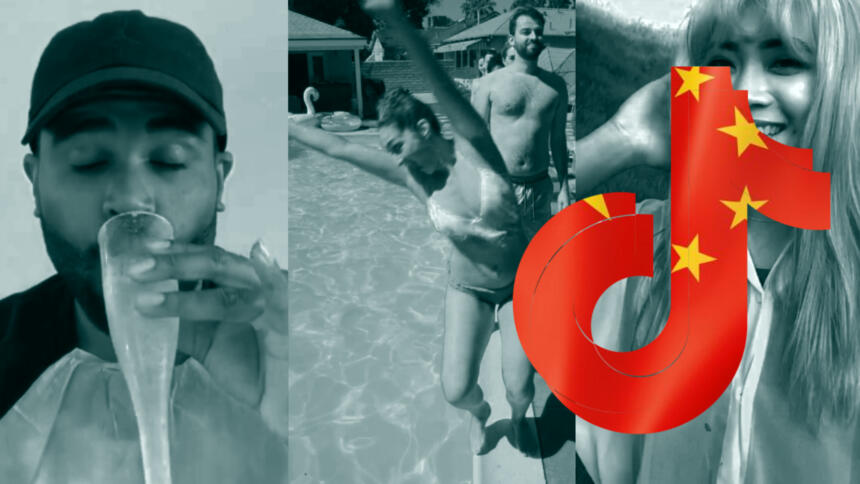
TikTok stands for fun and creativity. But freedom of speech on the platform is in bad shape. TikTok: Cheerfulness and censorship Never before has a platform grown as fast as TikTok. We have gained exclusive insight into its content moderation and are publishing excerpts from its moderation rules: TikTok operates a sophisticated system to identify, control, suppress and direct content. The platform can throttle videos of protests and demonstrations according to its rules.
-
: Voices Critical of Turkey mysteriously losing thousands of followers on Facebook

Kerem Schamberger loses friends on Facebook, although they did not have unfriended him themselves. : Voices Critical of Turkey mysteriously losing thousands of followers on Facebook On facebook, people and pages are suddenly losing thousands of friends and followers. Particularly affected were accounts criticizing Turkey. Facebook rejects accusations of censorship and claims to be taking measures against fake accounts among followers. However the accounts in question are genuine.
-
: re:publica 2017 – Die europäische Zensur-Maschine rollt an

Die Befürchtung: Upload-Filter werden zu massenhafter Zensur führen. : re:publica 2017 – Die europäische Zensur-Maschine rollt an Auf der re:publica 2017 sprachen Raegan MacDonald (Mozilla), Jake Beaumont-Nesbitt (International Music Managers Forum), Diego Naranjo (European Digital Rights) und Caroline De Cock (Copyright for Creativity) über von der EU-Kommission geplante Upload-Filter.
Ihre Kritik an diesen Filtern in zwei Sätzen:
Upload-Filter sind eine der größten Gefahren für ein offenes und freies Internet. -
: 32C3 zum Nachschauen: Zensur & digitale Selbstverteidigung
Quelle: <a href="http://www.thehungryandfoolish.com/2012/03/20/bizarre-censored-words-chinese-internet/">The Hungry and Foolish</a> : 32C3 zum Nachschauen: Zensur & digitale Selbstverteidigung In der Reihe unserer Vortragsempfehlungen des 32. Chaos Communication Congress geht es diesmal um Zensur und die Selbstverteidigung dagegen.
Ende Dezember letzten Jahres fand in Hamburg der 32. Chaos Communication Congress statt, von dem wir mehrfach berichtet haben. -
: Interview with BPjM-Leaker: Website Blacklists shouldn’t be done „in an intransparent way by a government“
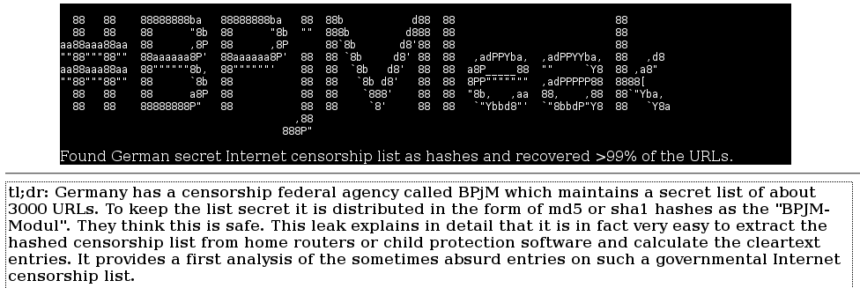
Screenshot of the website "BPJM-Leak" with a description of the hack and the extracted list of URLs. : Interview with BPjM-Leaker: Website Blacklists shouldn’t be done „in an intransparent way by a government“ An anonymous hacker has reverse-engineered and published the once-secret blacklist of URLs produced by a German federal agency. He or she did this mainly out of technical curiosity – and found that it was really easy to do. The hacker hopes not go get sued for this action – and offers a general critique on secret, state-sponsored internet censorship.
-
: Chinas Zensur: „System der tausend Augen“
: Chinas Zensur: „System der tausend Augen“ Lesenswerter und ausführlicher Artikel heute im Berliner Tagesspiegel: der Schriftsteller Ha Jin (哈金, eigtl. 金雪飞/金雪飛) berichtet über Chinas Zensur, „Das System der tausend Augen“. Es funktioniert nach dem Prinzip 內緊外鬆 (nèi jǐn wài sōng): nach innen hart, nach außen weich. In der Außendarstellung der Zensur ist also kaum erkennbar, wie unnachgiebig sie nach innen wirkt.