
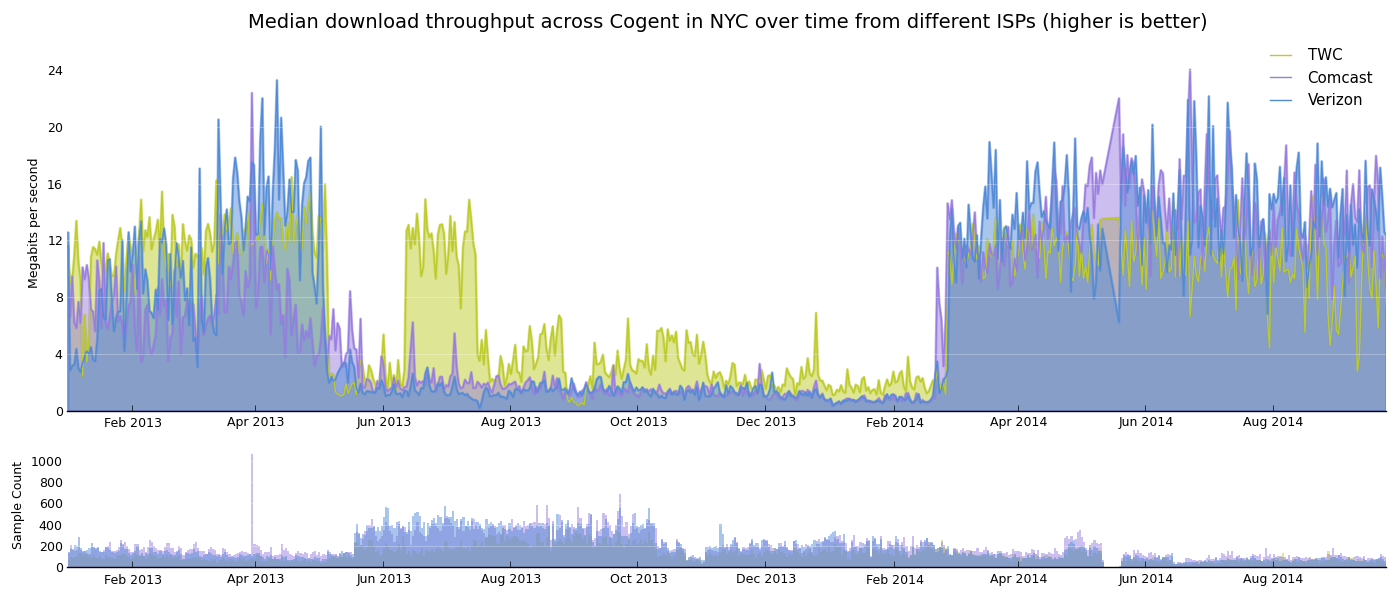
Das Measurement Lab (M‑Lab) hat Interconnection zwischen US-Providern untersucht: ISP Interconnection and its Impact on Consumer Internet Performance
Using Measurement Lab (M‑Lab) data, and constraining our research to the United States, we observed sustained performance degradation experienced by customers of Access ISPs AT&T, Comcast, Centurylink, Time Warner Cable, and Verizon when their traffic passed over interconnections with Transit ISPs Cogent Communications (Cogent), Level 3 Communications (Level 3), and XO Communications (XO). In a large number of cases we observed similar patterns of performance degradation whenever and wherever specific pairs of Access/Transit ISPs interconnected. From this we conclude that ISP interconnection has a substantial impact on consumer internet performance – sometimes a severely negative impact – and that business relationships between ISPs, and not major technical problems, are at the root of the problems we observed.
Auf deutsch: „Engpässe“ im Netz gibt es auch zwischen Providern, nicht nur auf der Leitung zum End-User. Das hat aber keine technischen Gründe, sondern ist eine Business-Entscheidug der Provider. YouTube ruckelt bei der Deutschen Telekom und Netflix ruckelt bei amerikanischen Kabel-Providern, aber nicht weil die Kapazität nicht da wäre, sondern weil die Anschluss-Anbieter mehr Geld dafür haben wollen. Erpressung statt Netzausbau.
Die Daten für die Studie kommen von weltweiten Messungen, an denen jeder teilnehmen kann. Auch unsere Freunde aus Österreich haben diese Daten bereits ausgewertet: netneutralitymap.org.
Mit der neuen Studie veröffentlicht das M‑Lab neue Daten für das Internet Observatory und neue Tools:
To help facilitate review, reproduction, and expansion of this work, M‑Lab is providing the research community with Telescope, a tool designed to make extraction of raw measurements simple and to allow easy reproduction of this and future research. Beyond telescope, and in keeping with our core principles, M‑Lab makes its full dataset and methodological documentation available in the public domain. Please review, revise, and join the discussion on our research discuss mailing list.