Schlagwort: english
-
Data Broker Files: How data brokers sell our location data and jeopardise national security

Located. (The data on this graphic is randomly generated and illustrative). Data Broker Files: How data brokers sell our location data and jeopardise national security The AdTech industry is torpedoing the privacy of millions of people in Germany and is a threat to national security. But the underlying problem is global: databrokers sell location data without sufficient control. This is the summary of a joint research by netzpolitik.org and BR.
-
Data Workers' Inquiry: The hidden workers behind AI tell their stories

A visualisation from the Zine "The Unknown Women of Content Moderation" by Botlhokwa Ranta Data Workers' Inquiry: The hidden workers behind AI tell their stories AI and content moderation would be impossible without the labor of millions of data workers. In a new project, these workers share their stories: from platform workers in Venezuela and Syria to employees of outsourcing companies in Kenya and content moderators in Germany.
-
EU Council discusses Digital Euro: And how much privacy should it be?

The Council is still cooking. EU Council discusses Digital Euro: And how much privacy should it be? Member states are negotiating rules for the planned digital currency, in particular exemptions from surveillance for offline transactions. A planned „single access point“ is a cause for concern, but additional privacy rules are also on the table. We publish working documents from recent months.
-
EUDI Wallet: A wallet full of loopholes

Auch Käse hat Löcher. Und manchmal riecht er streng. EUDI Wallet: A wallet full of loopholes Eighty per cent of all EU citizens should be using a digital wallet by 2030. A group of experts is working on the technical details for this. Because it is not adhering to the legal requirements, it is now being criticised by civil rights activists.
-
Victory, for now: No Majority on Chat Control for Belgium

There will be no vote on chat control today. Victory, for now: No Majority on Chat Control for Belgium The EU member states are unable to agree on a position on chat control today. The Council Presidency has removed the vote from the agenda because it does not have a sufficient majority. This means that Belgium has failed, and the presidency now goes to Hungary.
-
Client-Side-Scanning: Chat Control is Pure Surveillance State

Every picture sent is checked by the state at home at the desk before it is put in the envelope. You have to imagine chat control with letters to understand how deep the invasion of privacy is. Client-Side-Scanning: Chat Control is Pure Surveillance State The planned chat control makes the world less secure and more authoritarian, as it is directed against private and encrypted communication. Proponents are using disinformation, lies, and sleight of hand to push through the project. But chat control can still be stopped. A commentary.
-
Going Dark: EU States Push for Access to Encrypted Data and Increased Surveillance

Going Dark: EU States Push for Access to Encrypted Data and Increased Surveillance Most EU member states welcome the demands of a group of experts for more surveillance. The panel was criticized in advance for being biased and one-sided. Nevertheless, there is hardly any opposition to the panel’s recommendations, as a secret protocol that we are publishing shows.
-
European Election: German Pirates will not re-enter EU Parliament

The Pirates have suffered a shipwreck. European Election: German Pirates will not re-enter EU Parliament The right wing dominates the polls, Volt makes gains. The clear losers are the Greens – and the Pirates. Anja Hirschel, heir to Patrick Breyer, misses her entry into Parliament. The Czech Pirates also drop to a single seat.
-
Interview: AI at Europe’s Borders

“Against Automated Fortress Europe” at re:publica24 Interview: AI at Europe’s Borders People on the move face dehumanizing and discriminatory treatment at Europe’s borders. Yet, the EU continues to fund projects that aim to automate these practices with the help of AI and by this exacerbates the plight of migrants. An interview with Antonella Napolitano and Fabio Chiusi.
-
Interview on location trackers: Google and Apple „are hoping to avoid being banned“

Location Trackers are often small and can easily be hidden in a bag. Interview on location trackers: Google and Apple „are hoping to avoid being banned“ AirTags can be super useful. But in women’s shelters they’re deadly. Topics such as stalking are a new thing for the standards organization IETF. But this is what was needed when discussing a standard for location trackers. Mallory Knodel says the IETF should be proud of itself to be expanding its mandate.
-
Mastodon and Peertube: EU closing up shop in Fediverse because nobody wants to run servers

The EU wants to close its Mastodon server. (symbolic image) Mastodon and Peertube: EU closing up shop in Fediverse because nobody wants to run servers EU institutions are active on Mastodon and Peertube servers, thanks to a pilot project run by the European Data Protection Supervisor. But they’ll be shut down in May – because nobody wants to be responsible for them.
-
European data broker: Sensitive passport data of Germans published online

European data broker: Sensitive passport data of Germans published online A data broker is offering sensitive passport data of thousands of people for sale – and publishing some of it openly online. Our investigation leads to an airline as a possible source. Data protection authorities are alarmed.
-
"Artificial Intelligence": Automated Warfare and the Geneva Convention

Who makes the decisions in automated warfare? And who bears the responsibility? "Artificial Intelligence": Automated Warfare and the Geneva Convention Warfare is becoming digitalized and automated. This is shifting the role of citizens within the Geneva Conventions. We urgently require new solutions and international agreements.
-
Taurus leak: When it comes to privacy, it’s all or nothing

If communication is not encrypted, others can listen in. Taurus leak: When it comes to privacy, it’s all or nothing The German Taurus leak shows one thing very clearly: encrypted and secure communication does not work for the few. Instead, it must become the standard for everyone.
-
Platform Work: Member states torpedo workers’ rights

No go for workers' rights. Platform Work: Member states torpedo workers’ rights The planned Directive on Platform Work was supposed to be done, but now there are new problems: EU member states did not agree with the trilogue compromise, endangering the whole project.
-
AI Act: The Member States’ Wish List

Which of their wishes will be fulfilled? AI Act: The Member States’ Wish List A document from the AI Act trilogue shows what member states were hoping to push through: Automated classification of people by race, emotion recognition, biometric analysis of video recordings. In some parts, the outcome is still unclear.
-
EU country comparison: How data brokers are screening us
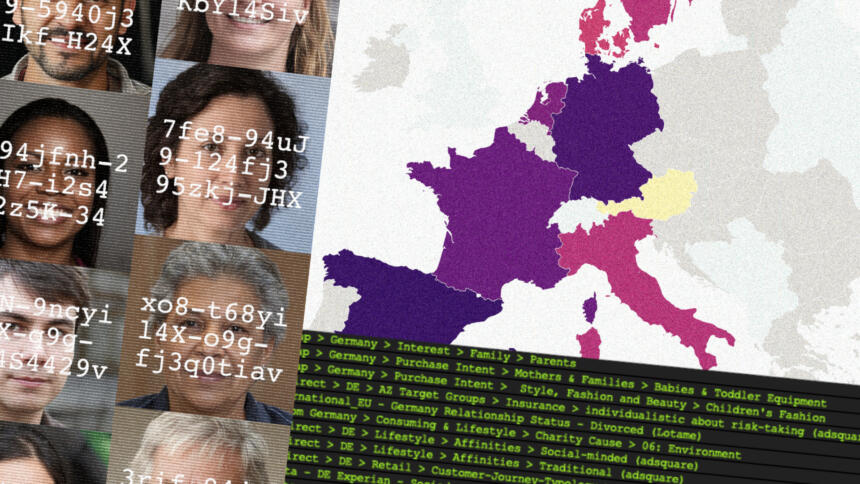
We combed through hundreds of thousands of segments of the advertising industry EU country comparison: How data brokers are screening us For targeted advertising, data brokers want to know about our bank accounts, children and illnesses. Our data research shows the dimension of this dubious business for the first time in a European country comparison. Experts call it a „catastrophe“.
-
Interview: „TikTok’s power to say no is shrinking by the day“

Rebecca Arcesati has been researching China’s digital policies for years Interview: „TikTok’s power to say no is shrinking by the day“ TikTok is struggling to convince Western politicians it is not a security threat. But governments are right to ban the app from official devices, says China expert Rebecca Arcesati. Still she warns the biggest threat is Europe and the US giving up on their democratic values in dealing with TikTok.
-
Archive Team: Shutdowns don’t stop during the weekends

Logo shown after the start of a Warrior VM Archive Team: Shutdowns don’t stop during the weekends The Internet does not forget? The opposite is the case. Huge mountains of data are lost on the internet every day. That’s why the Archive Team scours the vastness of the WWW and rescues data from extinction – around the clock and on a voluntary basis.
-
A Call to Action: Universities of the World, Join the Fediverse!

Dieses Bild ziert die <a href="https://mastodon.mit.edu/about">Mastodon-Instanz des Massachusetts Institute of Technology (MIT)</a>. A Call to Action: Universities of the World, Join the Fediverse! While there is a lot of discussion about new Twitter alternatives and the relevance of journalists and other critical groups of users, the potential of university-based Fediverse instances has hardly been addressed. It is high time for universities to get involved in the Fediverse. This is a call to action.