
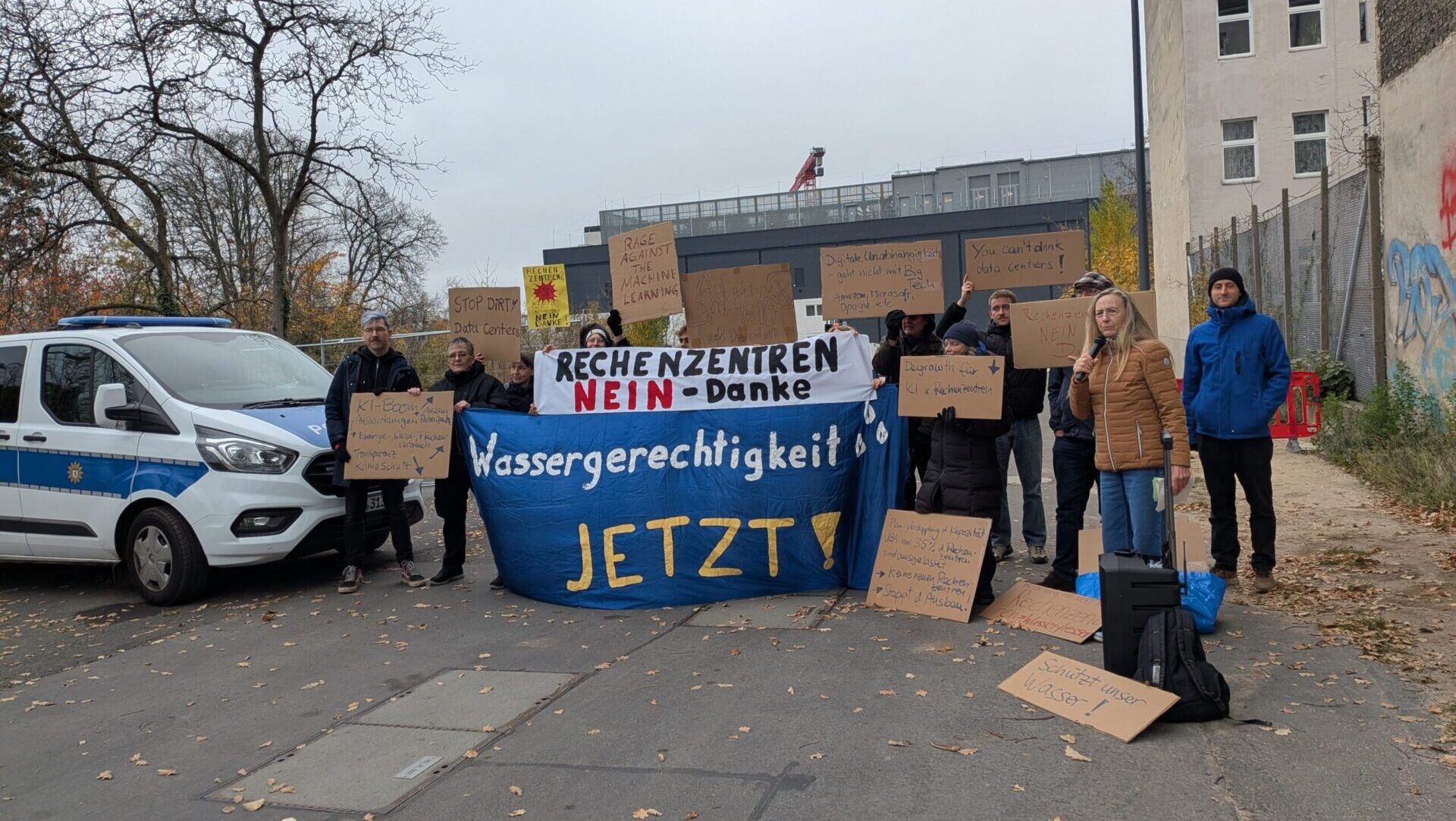
Activists rallied on Friday afternoon outside two data center campuses in Mariendorf, in the first protest against data centers and AI in Berlin according to the organizers. The sites extending over a former gas plant is fenced, with no sign of life but security personnel and construction workers. The banner held by the activists protesting in front of a windowless building reads “Data centers? No thank you!”
“We are just starting here in Berlin. This is the beginning of a wider movement, like the one we saw in the US,” said Caro Weber from Interventionistische Linke, the spokesperson for the protest.
On the cold November afternoon, activists are carrying handwritten signs on cardboard and cloth. Right next to them a police vehicle is standing. The small group has picked a powerful industry to challenge.
The afternoon was originally planned for an open house, where the public gets to visit the data center. But the operating company canceled the event for security reasons, Weber told netzpolitik.org. “We want to make these corporations that have a massive amount of power a bit frightened,” Weber said.
Activists protesting the AI industry seem to take their fight to its tangible infrastructure, the data center.
‘Like black boxes’
“I didn’t know there was a data center here!” a passerby commented on the protest. The fenced-off complex has no eye-catching signs.
Parts of the two campuses are already up and running, while others are still under construction. Once completed, the sites are set to host more than 100 megawatts (MW) of IT capacity, estimated to need as much power as tens of thousands of households.
The campuses are operated by NTT Data and Virtus, two foreign-based multinationals. Both are colocation providers: they rent out space, power and cooling to customers who house their own servers there.
“These data centers are like black boxes. We don’t know what they are used for. Are they used to create deepfakes? Are they used to create disinformation? Are they used for automated weapon systems? There is zero democratic control over what data centers and AI can be used for, and that is our concern,” Weber told netzpolitik.org.
“Such protests are definitely necessary to have more democratic voices to control and organize computing infrastructure,” Fabian Halfer, an urban researcher taking part in the protest, told netzpolitik.org. “During my research, finding information about this power-hungry infrastructure was hard. One obtains information through a lot of forensic research. It is quite opaque what the actual impacts are,” Halfer explained.
A first Europe-wide protest
“Your cloud dries my river,” “Not here, not anywhere” and “Data centers everywhere, democracy nowhere!” are among the slogans of opposition groups in Spain, Ireland and France taking part in the Days of Action this weekend. The campaign is organized by Stop Dirty Data Centres, a pan-European coalition of around 100 groups from 15 countries.
Large data centers run around the clock. They consume vast amounts of electricity and water, putting growing pressure on natural resources and public infrastructure. Campaigners say local communities are often left out of decisions that shape their environment and their future.
“Today, communities across Europe who have been challenging the imposition of energy, water and land-hungry data centers where they live are arriving on the political stage,” said Owen Espley, coordinator of the Stop Dirty Data Centres coalition.
Alles netzpolitisch Relevante
Drei Mal pro Woche als Newsletter in deiner Inbox.
The coalition is calling for an immediate moratorium on new large-scale data center projects, meaning a pause until social and environmental concerns have been addressed. It also wants clear rules on whether new facilities should be built, and under what conditions, with proper scrutiny and meaningful public participation.
The Days of Action come as the EU weighs a European Commission proposal to fast-track data centers.
Against fast-tracking hyperscalers
The proposed EU Cloud and AI Development Act aims to accelerate the build-out of data centers across the bloc. The plan would designate zones in which permitting may not take longer than 12 months. Within these zones, the Commission wants data centers to be treated as “strategic projects” under a separate EU regulation that speeds up environmental assessments.
The watchdog group Corporate Europe Observatory counted 367 recorded lobbying meetings on data center policy before the proposal was published.
“I am very fearful of that. The bottleneck right now when it comes to data centers is the planning process, during which communities can engage and make a difference. Labeling such projects as strategic and fast-tracking their permits hinders this democratic process, making it even harder than it already is,” Halfer said.
In the US, strong pushback against data center expansion contributed to heavy losses for the Republican Party in the midterm elections, despite the tech industry spending hundreds of millions of dollars to support Republican campaigns.
In July, the US movement against data centers mobilized around 140 protests in 42 states. Over the past two years, moratoriums were widely used in the US to block data center projects worth hundreds of billions of dollars.

Schreibe eine Ergänzung!